Effective PKU Management Requires Early and Lifelong Treatment1
PKU is a genetic disorder characterized by the body’s inability to break down the amino acid Phe.2
Elevated Phe levels pose significant risks at every stage of life1,3
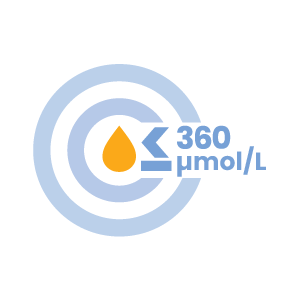
The American College of Medical Genetics and Genomics strongly recommends maintaining Phe levels of ≤360 µmol/L, emphasizing its link to higher IQ and improved cognitive outcomes. Clinical experience indicates there is no harm for people with PKU to have Phe levels of 30-120 µmol/L.
The challenges of a lifelong diet1,3-5
Diet alone often fails as the only strategy to help patients manage Phe levels, creating nutritional gaps, emotional distress, social isolation, and daily burdens. Other solutions are needed that work in conjunction with the PKU diet that may help patients overcome challenges and live fuller lives.
The need for early and consistent care1,2,6
Lifelong Phe management is crucial to prevent complications and optimize outcomes. Yet, current treatments may not work for everyone and often fall short, leaving a critical gap in care for individuals with PKU.
The lifelong impact of poorly controlled Phe1
EARLY CHILDHOOD
High Phe levels in early childhood can lead to irreversible cognitive impairment, developmental delays, and behavioral challenges.3
ADOLESCENCE
During adolescence, poor Phe control contributes to deficits in executive function, academic struggles, and social difficulties.3,7
ADULTHOOD
High Phe levels in adulthood can harm mental health, productivity, and quality of life, increasing the risks of anxiety, depression, and cognitive challenges.3
Stay informed
Sign up to receive updates, clinical insights, and resources straight to your inbox.
References: 1. Smith WE, Berry SA, Bloom K, et al. Phenylalanine hydroxylase deficiency diagnosis and management: A 2023 evidence‐based clinical guideline of the American College of Medical Genetics and Genomics (ACMG). GenetMed. 2025;27(1):101289. doi:10.1016/j.gim.2024.101289 2. Muntau AC, Longo N, Ezgu F, et al. Effects of oral sepiapterin on blood Phe concentration in a broad range of patients with phenylketonuria (APHENITY): results of an international, phase 3, randomised, double-blind, placebo-controlled trial. Lancet. 2024;404(10460):1333–1345. doi:10.1016/S0140‐6736(24)01556‐3 3. Ashe K, Kelso W, Farrand S, et al. Psychiatric and cognitive aspects of phenylketonuria: The limitations of diet and promise of new treatments. FrontPsychiatry. 2019;10:561. doi:10.3389/fpsyt.2019.00561 4. Remor E, Gabe KM, Teruya KI, Doederlein Schwartz IV. What is known about patients’ quality of life with phenylketonuria and their caregivers? A scoping review. Orphanet J Rare Dis. 2024;19(1):402. doi:10.1186/s13023‐024‐03422‐4 5. Anton‐Păduraru DT, Trofin F, Chis A, et al. Current insights into nutritional management of phenylketonuria: An update for children and adolescents. Children (Basel). 2025;12(2):199. doi:10.3390/children12020199 6. Camp KM, Parisi MA, Acosta PB, et al. Phenylketonuria scientific review conference: state of the science and future research needs. Mol Genet Metab. 2014;112(2):87–122. doi:10.1016/j.ymgme.2014.02.013 7. Blau N, van Spronsen FJ, Levy HL. Phenylketonuria. Lancet. 2010;376(9750):1417–1427. doi:10.1016/S0140-6736(10)60961-0
You are now leaving the SEPHIENCE website and will enter a website operated by an independent third party. The links to third-party websites contained on this website are provided solely for your convenience. PTC Therapeutics does not control the opinions, claims, or comments on any third-party website linked to this website; the policies and practices of those third parties will govern your activities at those websites.