APHENITY Study

APHENITY Study: From Identification to Confirmation

Two-part design: Identify responders, then confirm efficacy1,2

SEPHIENCE was evaluated in a two-part, global, double-blind, randomized, placebo-controlled study in patients with PKU. The primary endpoint was assessed by the mean change in blood Phe levels from baseline to Week 6 in the SEPHIENCE-treated group compared to the placebo group.

Description1,2

A 2-week open-label period identified participants aged ≥2 years with a ≥15% blood Phe reduction from baseline for Part 2.

SEPHIENCE

2 weeks

Washout Period

2 weeks

Baseline Characteristics2

Age <18 Years:

64%

Classical PKU:

23%

BH4 non-responsive:

36%

Response with SEPHIENCE1,2

73 percent

of patients had a ≥15% reduction in blood Phe

66 percent

of patients had a ≥30% reduction in blood Phe

In Part 2, 110 patients from Part 1 were randomized, with 109 meeting the threshold of a ≥15% reduction in blood Phe. However, 11 of these patients—who had a ≥15% but <30% reduction—were excluded from the primary analysis set (N=98).2

Description2

A 6-week study with dose escalation (‍20, 40, 60 mg‍/‍kg‍/‍day) assessed SEPHIENCE’s efficacy and safety against placebo.
Graphic showing study randomization comparing SEPHIENCE (n=56, 6 weeks) versus Placebo (n=54, 6 weeks)

Baseline
Characteristics2

Age <18 Years:

65%

Classical PKU:

17%

Consistent and Significant Phe Reduction1,2

APHENITY: Results observed across all ages, from pediatrics to adults2

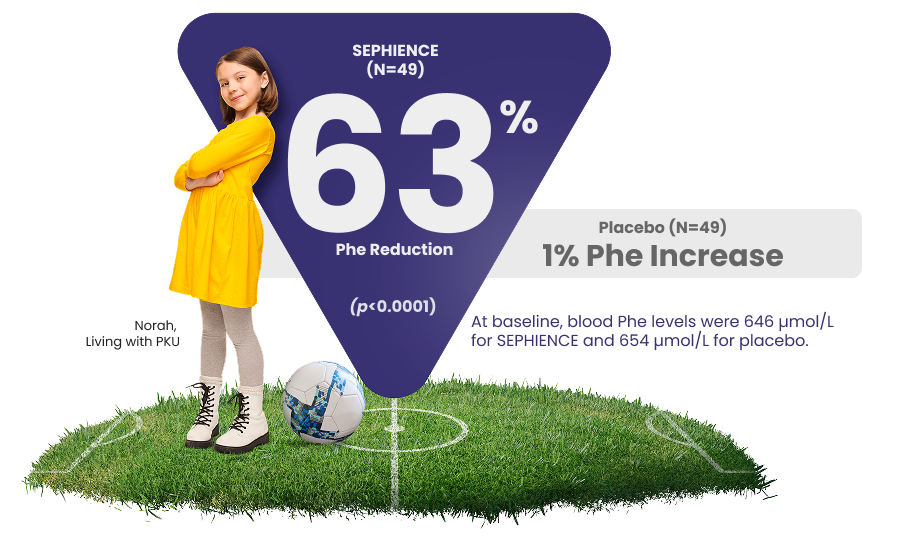
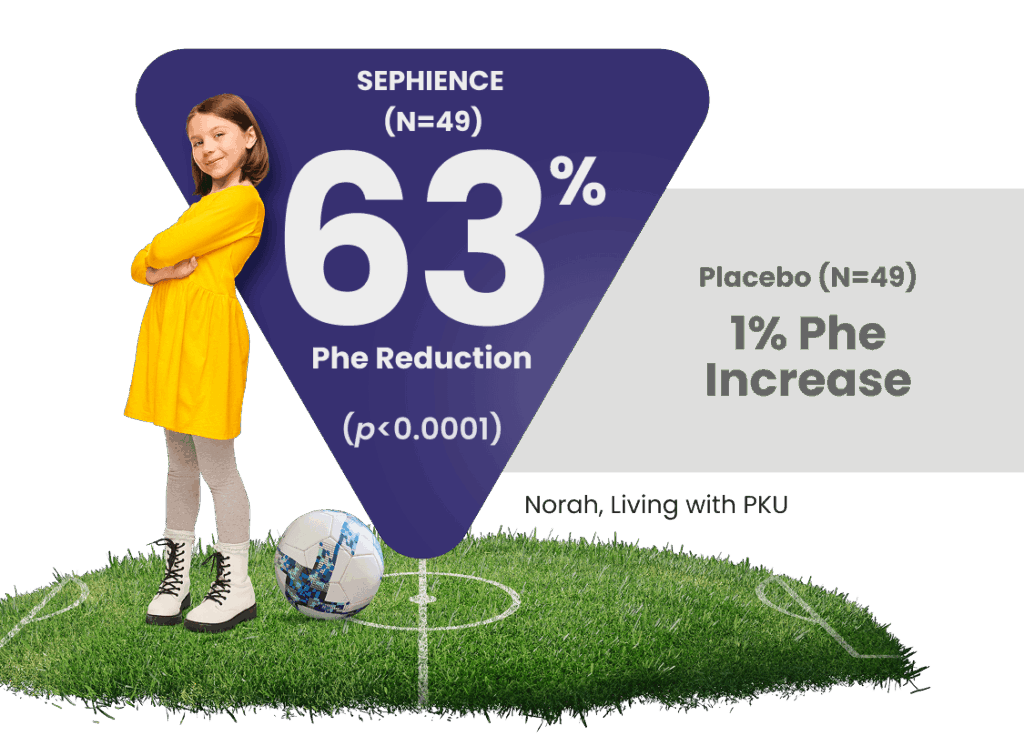
Mean % change in blood Phe levels from baseline to Week 6 in Part 2 (Primary analysis set: ≥30% Phe reduction from baseline during Part 1).1,2

Image showing reported 63% reduction in blood phenylalanine (Phe) for sepiapterin (SEPHIENCE)

At baseline, blood Phe levels were 646 µmol/L for SEPHIENCE and 654 µmol/L for placebo.

Additional Efficacy Analyses

The following analyses were not prespecified in the Phase 3 trial and are not included in the approved Prescribing Information for SEPHIENCE. Always refer to the full Prescribing Information for SEPHIENCE use. See additional study details below for more information.3

Considerable Responsiveness Across Subgroups

APHENITY subgroup analysis was consistent with the results of the primary efficacy2

Mean % Change in Blood Phe from Baseline to Week 6 in Part 22,3

Classical PKU

BH4 Non-Responsive

SEPHIENCE (N=6)

-69%

SEPHIENCE (N=13)

-54%

Placebo (N=9)

+3%

Placebo (N=10)

-12%

(p<0.0001)

(p=0.001)

At baseline, blood Phe levels were 761 µmol/L for SEPHIENCE and 772 µmol/L for placebo in patients with classical PKU, and 650 µmol/L for SEPHIENCE and 662 µmol/L for placebo in those who were BH4 non‍-‍responsive.3

The mean absolute change in blood Phe from baseline to Week 6 was greater with SEPHIENCE than with placebo in both classical PKU (-523 μmol/L vs -42 μmol/L) and BH4 non-responsive patients (-354 μmol/L vs -78 μmol/L).2,3

Muntau et al. 2024 Study Summary

Efficacy and safety of oral sepiapterin in patients with phenylketonuria (APHENITY)
A phase 3, double-blind, randomized, placebo-controlled study in participants with PKU aged 2 years and older across 34 sites in 13 countries.

The primary endpoint was mean change in blood Phe concentration from baseline to Week 6. Sepiapterin significantly reduced blood Phe concentration compared to placebo (least squares mean difference: -‍395.9 μmol/L; p<0.0001). Secondary analyses showed that 93% of participants with baseline blood Phe ≥‍600 µmol/L achieved levels <600 µmol/L, and 84% with baseline ≥360 µmol/L achieved levels <‍360 µmol/L with sepiapterin, compared to 30% and 9% with placebo, respectively (both p<0.0001). Additionally, 22% of sepiapterin-treated participants achieved normal Phe levels (35‍-120 µmol/L) compared to none with placebo.

Sepiapterin was well tolerated. The most common treatment-related TEAEs were mild gastrointestinal symptoms, with no deaths, serious adverse reactions, or severe adverse events reported.

Study Limitations

Only participants who were sepiapterin-responsive (≥15% Phe reduction) were randomized, and the study duration was limited to 6 weeks.

Financial Disclosures of Study Sponsors

Funded by PTC Therapeutics, Inc.

Muntau AC, Longo N, Ezgu F, et al. Effects of oral sepiapterin on blood Phe concentration in a broad range of patients with phenylketonuria (APHENITY): results of an international, phase 3, randomised, double-blind, placebo-controlled trial. Lancet. 2024;404(10460):1333-1345.
Achieving Guideline-Target Blood Phe Levels

APHENITY: Percentage of patients who reached US guideline target levels (all ages)

US guidelines for all ages2

84%

of patients treated with SEPHIENCE reached 
≤360 μmol/L (n=37/44)*

*In patients with blood Phe ≥360 μmol/L at baseline vs 9% (n=4/43) with placebo (OR: 51.54, 95% CI: 12.28-254.34; p<0.0001)2

Percentage of patients who achieved normalized blood Phe levels (e.g., within 35‍–‍120 µmol/L)2

22%

of patients treated with SEPHIENCE had blood Phe levels within the normal range (n=11/49) vs 0% (n=0/49) of patients with placebo

*In patients with blood Phe ≥360 μmol/L at baseline vs 9% (n=4/43) with placebo (OR: 51.54, 95% CI: 12.28-254.34; p<0.0001)2

Muntau et al. 2024 Study Summary

Efficacy and safety of oral sepiapterin in patients with phenylketonuria (APHENITY)
A phase 3, double-blind, randomized, placebo-controlled study in participants with PKU aged 2 years and older across 34 sites in 13 countries.

The primary endpoint was mean change in blood Phe concentration from baseline to Week 6. Sepiapterin significantly reduced blood Phe concentration compared to placebo (least squares mean difference: –‍395.9 μmol/L; p<0.0001). Secondary analyses showed that 93% of participants with baseline blood Phe ≥600 µmol/L achieved levels <600 µmol/L, and 84% with baseline ≥360 µmol/L achieved levels <360 µmol/L with sepiapterin, compared to 30% and 9% with placebo, respectively (both p<0.0001). Additionally, 22% of sepiapterin-treated participants achieved normal Phe levels (35‍-120 µmol/L) compared to none with placebo.

Sepiapterin was well tolerated. The most common treatment-related TEAEs were mild gastrointestinal symptoms, with no deaths, serious adverse reactions, or severe adverse events reported.

Study Limitations

Only participants who were sepiapterin-responsive (≥15% Phe reduction) were randomized, and the study duration was limited to 6 weeks.

Financial Disclosures of Study Sponsors

Funded by PTC Therapeutics, Inc.

Muntau AC, Longo N, Ezgu F, et al. Effects of oral sepiapterin on blood Phe concentration in a broad range of patients with phenylketonuria (APHENITY): results of an international, phase 3, randomised, double-blind, placebo-controlled trial. Lancet. 2024;404(10460):1333-1345.

Consistent Safety Profile Across Age Groups1,2

APHENITY Safety: Most adverse reactions were mild or moderate2

Warnings and Precautions:

  • Increased Bleeding: SEPHIENCE may increase the risk of bleeding. Consider treatment interruption in patients with active bleeding
  • Hypophenylalaninemia: Some pediatric PKU patients experienced hypophenylalaninemia; monitor patients’ blood Phe levels during treatment
  • Interaction with Levodopa: Seizures, over-stimulation, or irritability may occur; monitor patients for a change in neurologic status

Adverse Reactions That Occurred in ≥2% of SEPHIENCE-Treated Patients and Greater Than in Placebo (APHENITY, Part 2‍)‍1

Slide table to view more

Adverse Reaction
(Preferred Term)

Diarrhea

Headache

Abdominal pain*

Hypophenylalaninemia

Feces discolored

Oropharyngeal pain

SEPHIENCE (%)

N=56

4 (7)

4 (7)

3 (5)

2 (4)

2 (4)

2 (4)

Placebo (%)

N=54

1 (2)

1 (2)

1 (2)

0

0

1 (2)

*Includes abdominal pain, abdominal pain upper, and abdominal discomfort.

Proven safety profile with no serious adverse reactions reported1,2

No treatment-related serious adverse events were reported in SEPHIENCE-treated PKU patients in clinical trials.1,2

Adverse reactions were similar across both adult and pediatric populations, except for hypophenylalaninemia, which was observed in 5% (n=2/37) of pediatric patients but not in any adult patients in APHENITY Part 2.1

Stay informed

Sign up to receive updates, clinical insights, and resources straight to your inbox.

BH4: Tetrahydrobiopterin; CI: Confidence interval; OR: Odds ratio; Phe: Phenylalanine; PKU: Phenylketonuria; TEAEs: Treatment-emergent adverse events.

References: 1. SEPHIENCE. Package Insert. PTC Therapeutics, Inc; 2025. 2. Muntau AC, Longo N, Ezgu F, et al. Effects of oral sepiapterin on blood Phe concentration in a broad range of patients with phenylketonuria (APHENITY): results of an international, phase 3, randomised, double-blind, placebo-controlled trial. Lancet. 2024;404(10460):1333–1345. doi:10.1016/S0140‐6736(24)01556‐3 3. Data on file. PTC Therapeutics, Inc; 2025.

You are now leaving the SEPHIENCE website and will enter a website operated by an independent third party. The links to third-party websites contained on this website are provided solely for your convenience. PTC Therapeutics does not control the opinions, claims, or comments on any third-party website linked to this website; the policies and practices of those third parties will govern your activities at those websites.